- Origin
- Italy
- Time
- About 4 hours
- Difficulty
- Medium
- Makes
- 2 loaves
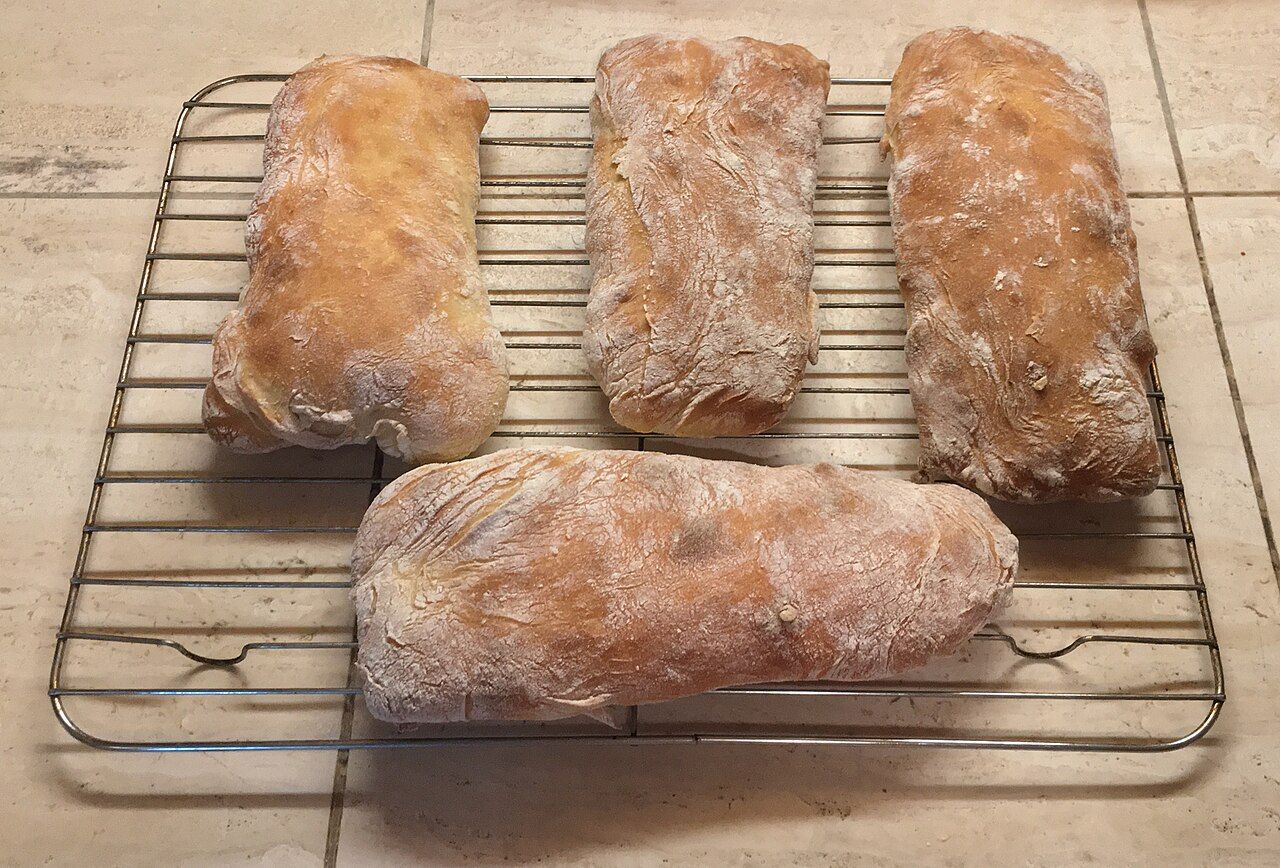
The name means "slipper" in Italian and comes from its flat, shapeless look. Contrary to what many assume, it is not an old bread: it was developed in 1982 in the Veneto region by the baker Arnaldo Cavallari, as an answer to the rise of the French baguette in Italy.
What makes ciabatta ciabatta is its very wet dough. It is not kneaded; it is folded, and handled as little as possible.
Method
- Mix. Stir all the ingredients together with a spoon. The dough will be almost pourable.
- Fold. Four times, 30 minutes apart, take hold of an edge with a wet hand, pull it up and fold it over. You will see the dough come together a little more each round.
- Let it rise. After the last fold, leave for 1–1.5 hours, until the dough is full of bubbles.
- Divide. Flour the counter generously. Tip the dough out without knocking out the gas and flour the top. Cut it in two with a dough scraper and stretch each piece gently into a rectangle. Do not try to shape it.
- Rest. Move onto baking parchment and leave for 30–40 minutes. Heat the oven, with its tray inside, to 240 °C (465 °F).
- Bake. Slide the parchment onto the hot tray and pour hot water onto the oven floor tray for steam. Bake for 22–25 minutes.
Tips
- The secret of the big holes is keeping the gas in the dough while you handle it.
- Wet or flour everything that will touch the dough: your hands, the scraper, the counter.