- Origin
- Sudan
- Time
- About 1 day (mostly waiting)
- Difficulty
- Hard
- Makes
- About 12 sheets
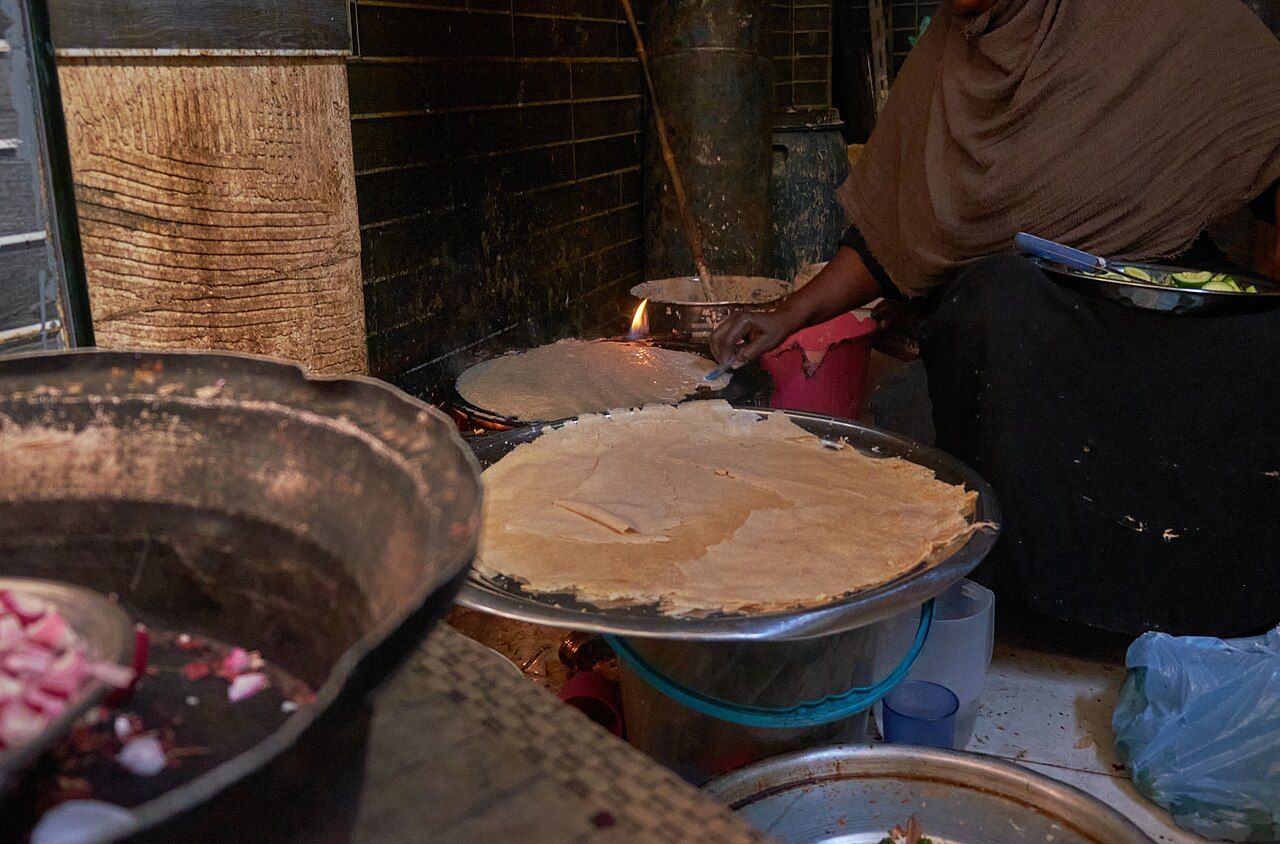
Sorghum is the staple grain of Sudan and South Sudan; it stands up to drought far better than wheat. Kisra is made from it: the flour is mixed with water, left to sour for a day, and the batter is spread wafer-thin over a hot, flat iron plate. The spreading is done with a small piece cut from a palm leaf, in a single quick stroke. The sheet that comes off is almost translucent, slightly sour and soft.
At the table the sheets are folded in a stack and dipped into the stews called mullah, made with okra or meat. It is a relative of Ethiopia's injera but much thinner. Made with sorghum alone, it is gluten-free.
Method
- Set up the batter. Whisk the sorghum flour, water and yogurt together. Cover and leave somewhere warm for 12–24 hours. Bubbles should form on the surface and it should smell sour.
- Adjust the consistency. Stir in the salt. The batter should be like a thin crêpe batter; if it is thick, add water.
- Heat the pan. Heat a wide non-stick pan over medium heat. Wipe it very lightly with a paper towel dipped in oil.
- Spread. Pour half a ladleful of batter at one edge of the pan and, with a flat spatula, pull it across to the opposite edge in one stroke, spreading it wafer-thin.
- Cook. Wait about 1 minute, until the edges dry and lift. It is not flipped.
- Remove. Take it by the edge, peel it off and lay it on a cloth. Once cool, the sheets can be stacked.
Tips
- The first few sheets tear; that is normal until the heat of the pan and the consistency of the batter settle.
- Sorghum flour is sold in shops that carry gluten-free products and online.
- The yogurt is only there to start the fermentation; a ladleful kept back from the previous batter does the same job.