- Origin
- Switzerland
- Time
- About 3 hours
- Difficulty
- Medium
- Makes
- 1 large braid
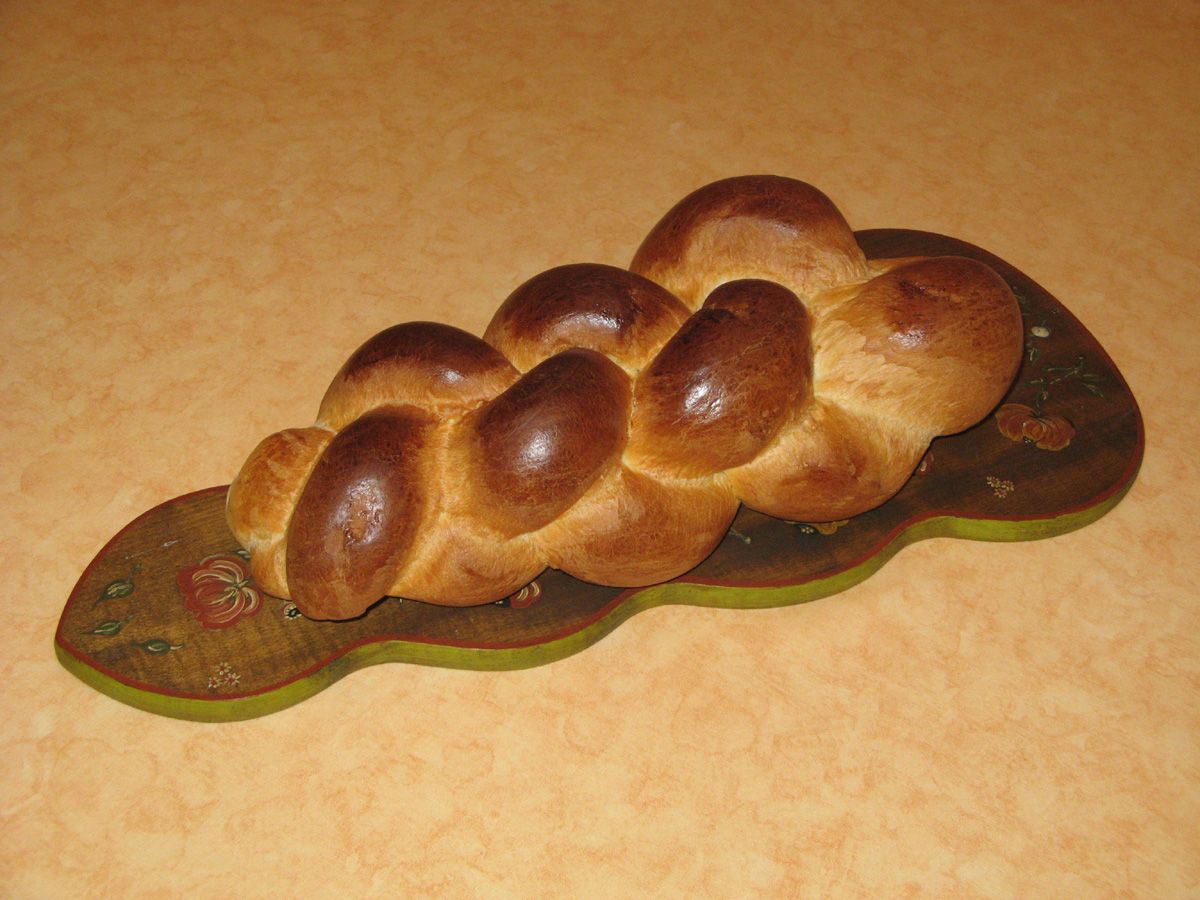
Zopf is German for "braid". In Switzerland it is the bread of Sunday mornings: kneaded or bought on Saturday evening and eaten at Sunday breakfast with butter, honey and jam. It resembles challah, but there is no egg in the dough: its softness comes from milk and butter, and its taste is plainer and milkier.
A traditional zopf is braided from two long ropes; bakers do this with a four-ended braid. An ordinary three-strand plait gives the same bread.
Method
- Knead the dough. Mix everything except the butter and knead for 5 minutes. Add the butter and knead for another 8–10 minutes, until the dough is smooth and elastic.
- Let it rise. Cover and leave until doubled in volume, about 1.5 hours.
- Make the ropes. Divide the dough in two. Roll each piece into a rope 60 cm (24 in) long, thick in the middle and thin at the ends.
- Braid. Lay the ropes across each other at their middles to form a cross. Swap the two ends of the lower rope over to the opposite sides, then the ends of the other rope; carry on in turn until the dough runs out. Tuck the ends underneath.
- Second rise. Leave on a parchment-lined tray for 40 minutes.
- Glaze. Loosen the egg yolk with a spoonful of milk and brush it on in two coats.
- Bake. Bake at 200 °C (400 °F) for 35–40 minutes, until deep golden.
Tips
- The four-ended braid can go wrong the first time; divide the dough into three ropes and make the plait you know.
- Two coats of egg yolk give that glossy, dark crust.