- Origin
- Paraguay
- Time
- About 45 minutes
- Difficulty
- Easy
- Makes
- 16 rings
Whenever a bus stops in Paraguay, a woman with a basket on her head steps on board selling hot chipá; these vendors are called chiperas. Chipá is the country's best-loved food, and its roots reach into two worlds: cassava starch was the staple of the indigenous Guaraní people, while cheese, eggs and milk arrived with the Jesuit missions in the seventeenth century.
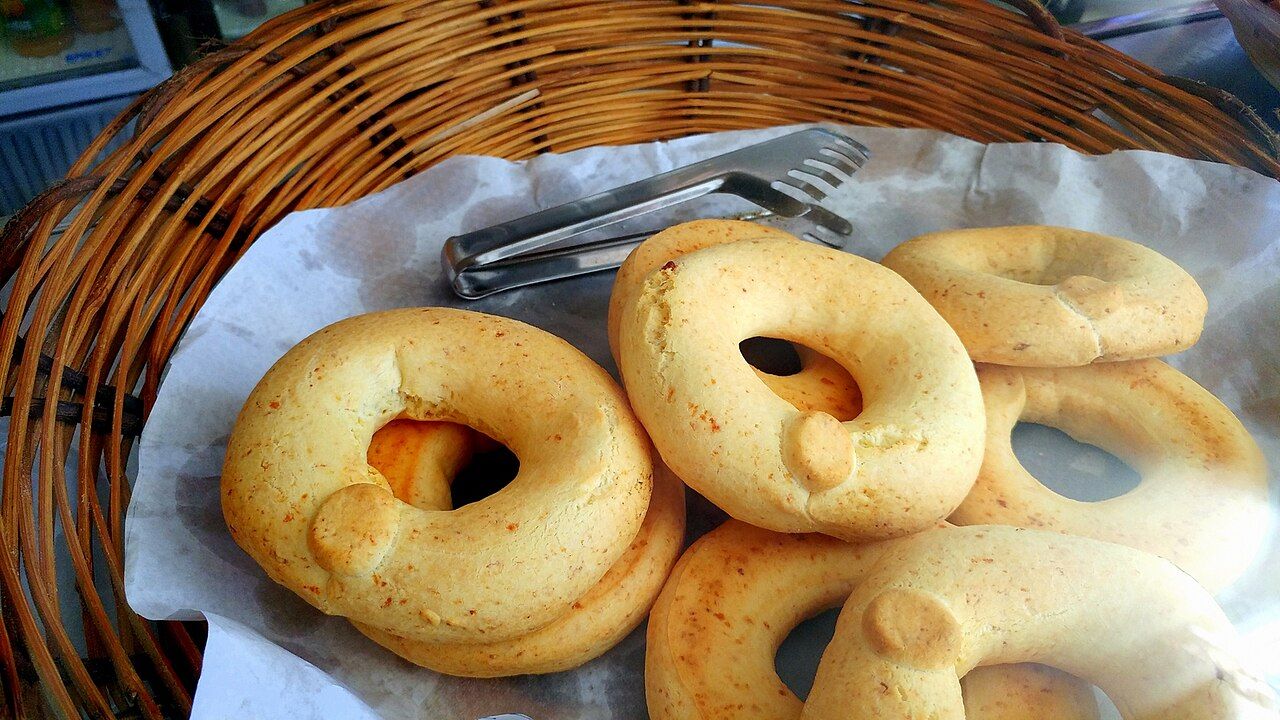
It is crisp outside and chewy and stretchy inside, and it is at its best the moment it leaves the oven. In the week before Easter it is made in large batches at home. It contains no wheat. It is a relative of Brazil's pão de queijo; the differences are the ring shape and the anise.
Method
- Heat the oven. Heat the oven to 220 °C (425 °F) and line a tray with baking parchment.
- Mix. Combine the starch, salt and aniseed in a bowl. Add the butter and rub it in with your fingertips.
- Add the cheese and eggs. Stir in the cheese and eggs.
- Add the milk. Add the milk a little at a time, kneading as you go. The dough should be smooth, soft and able to take a shape without cracking; add another spoonful or two of milk if needed.
- Make rings. Divide the dough into 16 pieces. Roll each into a 12 cm (5 in) rope and join the ends.
- Bake. Space them out and bake for 15–18 minutes, until the tops crack and golden spots appear.
Tips
- They are eaten hot; they harden as they cool. A few minutes in the oven softens them again.
- The more mature and salty the cheese, the more pronounced the flavor.
- The shaped rings can be frozen and go into the oven without thawing.