- Origin
- Italy (Puglia)
- Time
- About 18 hours (mostly waiting)
- Difficulty
- Medium
- Makes
- 1 large loaf
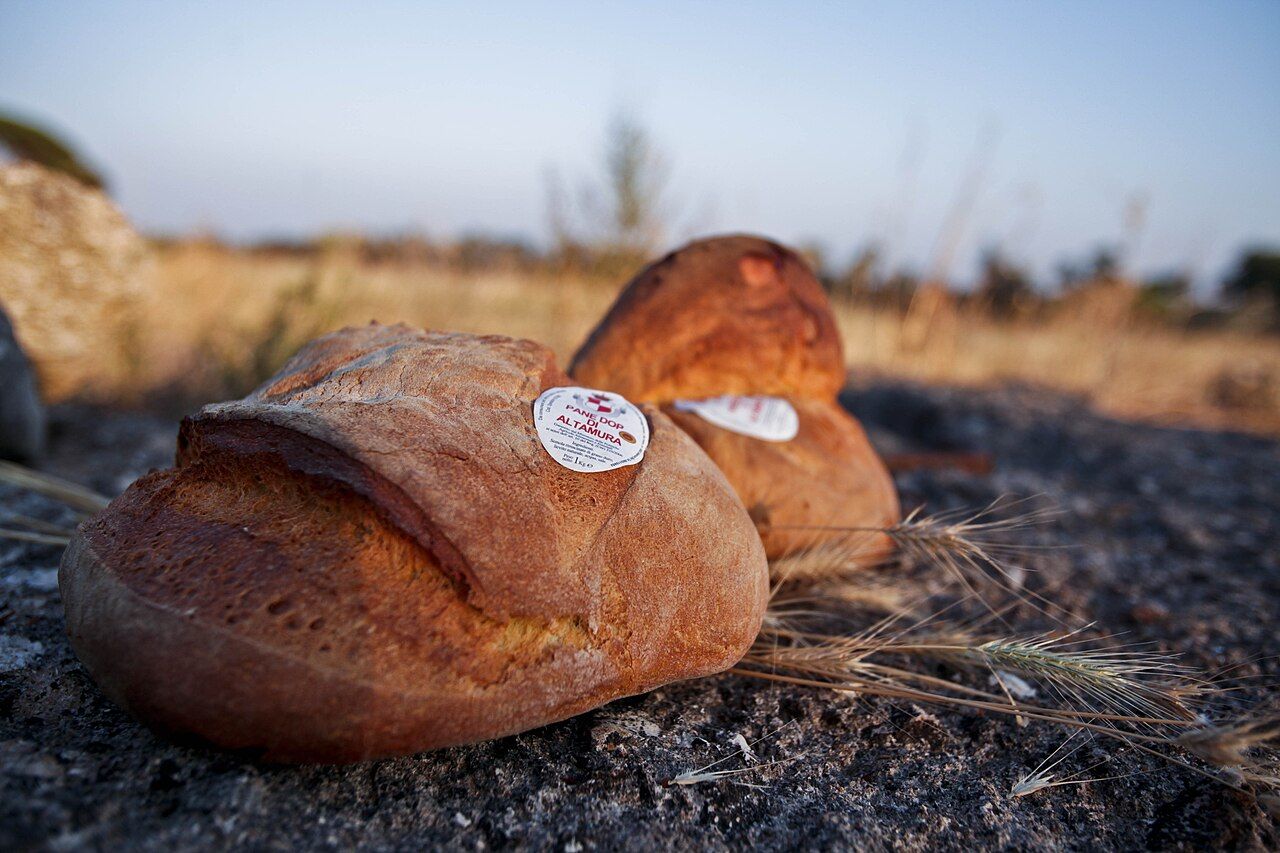
Altamura is a town in Puglia, the heel of Italy, in the middle of durum wheat fields. Its bread is made only from twice-milled durum semolina and sourdough; the crumb is straw yellow and the crust at least three millimeters thick. It was baked for shepherds and farmers and eaten over a week or even longer. The Roman poet Horace is said to have praised the bread of this area.
In 2003 it became the first bread in the European Union to receive a protected designation of origin (PDO). Its traditional shape is a tall, "overlapped" loaf made by folding the dough over itself.
The recipe below uses an overnight preferment in place of sourdough.
Method
- Set up the preferment. The evening before, mix the semolina flour, water and pinch of yeast. Cover and leave at room temperature for 12 hours.
- Knead the dough. Add the remaining ingredients to the preferment and knead for 10–12 minutes. Durum dough feels sandy at first and turns smooth as you knead.
- Let it rise. Cover and leave for 2.5–3 hours, folding once during the first hour.
- Shape. Round the dough and rest for 20 minutes. Then form a thick disc and fold one half over the other without closing it completely. Leave on a floured cloth for 45 minutes.
- Bake. Heat the oven, with its tray inside, to 250 °C (480 °F). Move the bread onto the hot tray; after 15 minutes lower the heat to 200 °C (400 °F) and bake for another 35–40 minutes. The crust should be dark brown.
- Wait. Cool completely on a rack.
Tips
- If you cannot find fine semolina flour, run fine semolina in a food processor for a few minutes.
- The thick crust is not a flaw of this bread but the reason it keeps.
- Once stale it is moistened and eaten with tomato and olive oil.